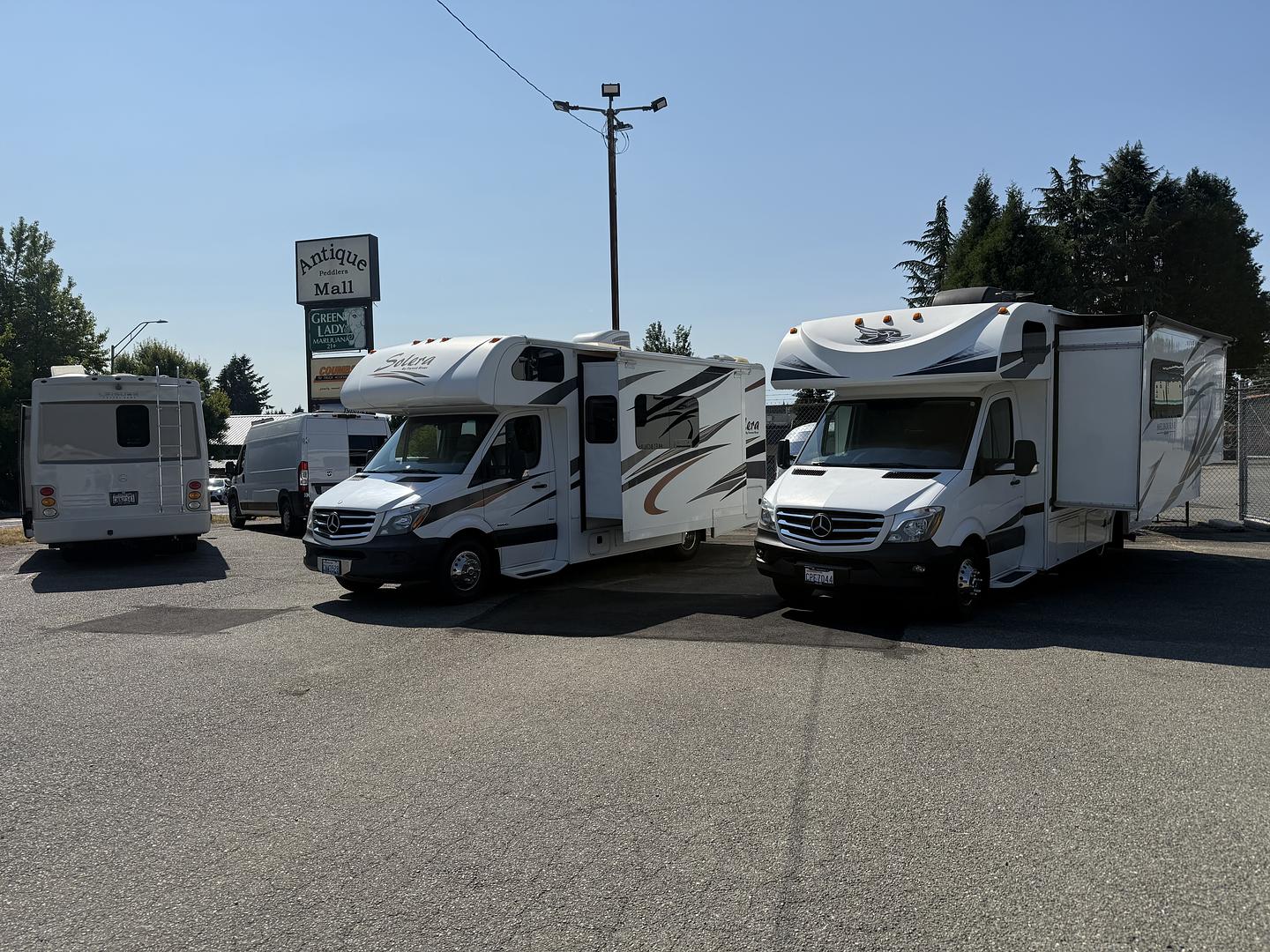

When shopping for a motorhome, one of the biggest questions we hear at Coumbs RV is:
"How many miles per gallon does it get?"
The honest answer is: it depends more on the chassis than the RV manufacturer.
A Winnebago, Coachmen, Thor, Forest River, Jayco, or Tiffin built on the same chassis will usually achieve very similar fuel economy. Weight, driving speed, terrain, wind, and towing all have a significant impact on real-world mileage.
Because nearly all motorhome chassis exceed the weight limits for EPA fuel economy testing, there are no official EPA MPG ratings. The numbers below come from manufacturer testing, long-term owner reports, and independent automotive publications.
Typical Motorhome Fuel Economy
Chassis City MPG Highway MPG Average MPG
Mercedes-Benz Sprinter Diesel 15–18 18–22 17–20
Ram ProMaster 3.6L Gas 13–15 15–18 14–17
Ford Transit Gas 13–15 15–18 14–17
Ford E-350 9–11 11–13 10–12
Ford E-450 7–9 9–11 8–10
Gas Class A (Ford F53) 6–8 7–9 6–8
Diesel Pusher Class A 7–9 8–10 8–10
Mercedes-Benz Sprinter
If fuel economy is your top priority, the Mercedes Sprinter remains the benchmark. Most Sprinter-based Class B vans and compact Class C motorhomes routinely achieve 17–20 MPG, with many owners reporting over 20 MPG on long highway trips.
Common Sprinter-based RVs include:
- Winnebago View
- Winnebago Navion
- Leisure Travel Unity
- Airstream Interstate
- Coachmen Galleria
- Thor Sanctuary
The tradeoff is higher purchase price and typically higher maintenance costs than gasoline-powered alternatives.
Ram ProMaster
The Ram ProMaster has become one of the most popular Class B chassis because it balances affordability with respectable fuel economy.
Typical real-world mileage:
- City: 13–15 MPG
- Highway: 15–18 MPG
Popular ProMaster motorhomes include:
- Winnebago Travato
- Roadtrek Zion
- Thor Tellaro
- Coachmen Beyond
- Entegra Ethos
Front-wheel drive also gives the ProMaster one of the lowest floor heights in the industry, making it easier to move around inside.
Ford Transit
Ford's Transit has quickly become a favorite for manufacturers building smaller motorhomes.
Typical fuel economy:
- City: 13–15 MPG
- Highway: 15–18 MPG
You'll commonly see the Transit under:
- Winnebago Ekko
- Coachmen Beyond
- Pleasure-Way Ontour
- Thor Sequence
The Transit offers a great balance of fuel economy, service availability, and purchase price.
Ford Econoline (E-Series)
For decades, the Ford E-Series has been the backbone of the North American Class C market.
Ford E-350
Typical mileage:
- City: 9–11 MPG
- Highway: 11–13 MPG
Usually found under smaller Class C coaches.
Ford E-450
The E-450 carries heavier coaches and is by far the most common Class C chassis in America.
Typical mileage:
- City: 7–9 MPG
- Highway: 9–11 MPG
Popular models include:
- Coachmen Leprechaun
- Forest River Sunseeker
- Thor Four Winds
- Jayco Redhawk
- Winnebago Minnie Winnie
Although it isn't the most fuel-efficient option, the E-450 has earned a reputation for durability and widespread service availability.
Gas Class A Motorhomes
Most gas-powered Class A motorhomes ride on the Ford F53 chassis.
Expect:
- 6–8 MPG overall
Common models include:
- Fleetwood Bounder
- Tiffin Allegro Open Road
- Winnebago Adventurer
- Forest River Georgetown
- Thor A.C.E.
- Newmar Bay Star
Larger coaches naturally consume more fuel, especially at interstate speeds or while towing.
Diesel Pushers
While they're much larger than gas coaches, diesel pushers are surprisingly efficient for their size thanks to high-torque diesel engines.
Typical fuel economy:
- 8–10 MPG
Examples include:
- Tiffin Phaeton
- Newmar Dutch Star
- Fleetwood Discovery
- Winnebago Journey
- Entegra Aspire
They're also quieter, smoother to drive, and better suited for long-distance travel.
What Affects Motorhome Fuel Economy?
Several factors have a bigger impact than many shoppers realize:
- Driving speed (above 65 MPH fuel economy drops quickly)
- Wind direction
- Mountain driving
- Vehicle weight
- Towing a car or trailer
- Tire pressure
- Aerodynamic accessories such as roof racks and cargo boxes
Even two identical motorhomes can differ by several MPG depending on how and where they're driven.
Which Chassis Is Right for You?
Best Fuel Economy
Mercedes-Benz Sprinter
Ideal for travelers putting on lots of highway miles who want maximum efficiency.
Best Overall Value
Ford Transit or Ram ProMaster
Excellent balance of purchase price, maintenance costs, and fuel economy.
Most Proven Class C Platform
Ford E-450
Reliable, easy to service almost anywhere, and capable of carrying larger family-sized motorhomes.
Best for Large Luxury Coaches
Diesel Pushers
If comfort, towing capacity, and long-distance touring are your priorities, diesel pushers remain the gold standard.
Visit Coumbs RV
At Coumbs RV, we carry a wide variety of pre-owned motorhomes built on Ford, Mercedes-Benz, Ram, and other popular chassis. Whether you're looking for maximum fuel efficiency, room for the whole family, or a luxury diesel coach for cross-country adventures, we're happy to help you compare your options and find the RV that fits your travel style.
Have questions about a specific motorhome? Stop by our dealership or contact our team—we're always happy to help.
Sources
- MotorTrend – Mercedes-Benz Sprinter 2500 Yearlong Review (real-world fuel economy): https://www.motortrend.com/reviews/2024-mercedes-benz-sprinter-2500-awd-yearlong-review-update-7-different-types-of-fuel/
- RV Trader – Most Fuel Efficient Class B RVs: https://www.rvtrader.com/blog/2025/08/21/top-fuel-efficient-class-b-rv/
- RV Travel – Sprinter vs. Transit vs. ProMaster: https://www.rvtravel.com/sprinter-transit-van-promaster-van-rving-2901/
- Good Sam Community – Long-term owner MPG discussion for E-450 and other motorhomes: https://community.goodsam.com/discussions/rvnewbiesforum-board/motor-home-mpg/2486531/replies/2486553